
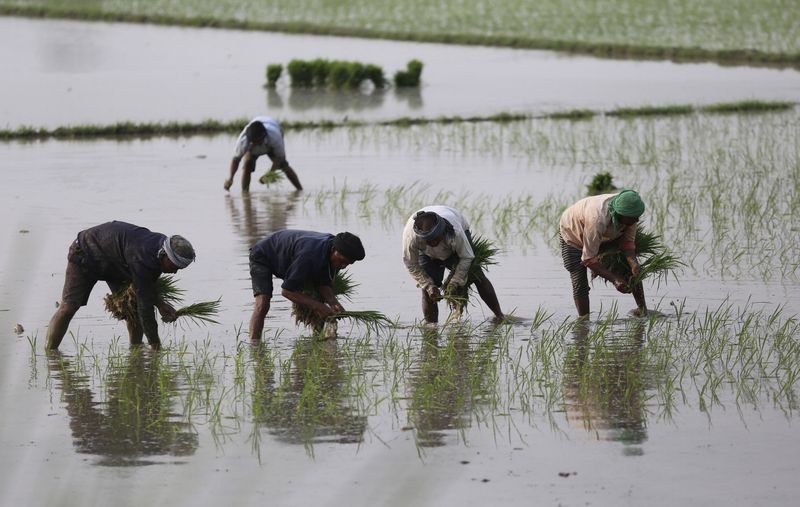
Despite early sowing of paddy and expectations of a bumper crop, Punjab witnessed lower electricity consumption during the ongoing paddy season as widespread and timely monsoon showers eased pressure on tubewells. Officials of the Punjab State Power Corporation Limited (PSPCL) said the corporation was able to save crores on free power while managing demand more efficiently through increased hydro generation.
Experts project that the state is headed towards a record kharif harvest, with paddy yield expected to touch 185 lakh tonnes—slightly higher than last year’s 182 lakh tonnes. Data shows that in the past two-and-a-half months, power supply stood at around 235,300 lakh units (LU), nearly 5 per cent lower than last year’s 242,460 LU for the same period. Power purchases from all sources also declined to 181,300 LU against 184,400 LU last year.
Daily average power supply during June, July, and up to August 16 was recorded at 3052 LU, 3095 LU, and 2993 LU, respectively, compared to 2918 LU, 3352 LU, and 3190 LU during the same stretch in 2023. PSPCL officials said consistent rainfall helped reduce the heavy dependence on over 13 lakh tubewells that typically consume vast amounts of electricity during irrigation. Each tubewell pumps out more than 30 lakh liters of water a week with an average of eight hours of supply.
“This is the first time in years that demand has declined, as regular rains not only reduced stress on underground water but also cut down the free power burden on the government,” experts noted. With more than 118 blocks in Punjab already declared “dark zones” due to falling water tables, they cautioned that continued reliance on early sowing and heavy groundwater extraction could accelerate desertification.
The daily average power purchase this season has also dropped to 2324 LU in June, 2392 LU in July, and 2340 LU till mid-August, compared to 2170 LU, 2560 LU, and 2486 LU, respectively, last year. Notably, this year’s paddy transplantation began on June 1, ten days earlier than in 2023 and a fortnight ahead of the earlier schedule of June 15 set in 2014 to align with the monsoon. Agriculture experts have long argued for pushing the transplantation date beyond June 20 to minimize groundwater stress, as the crop—grown across 31 lakh hectares, 73 per cent of which depend on tubewells—requires massive water inputs through the season.