
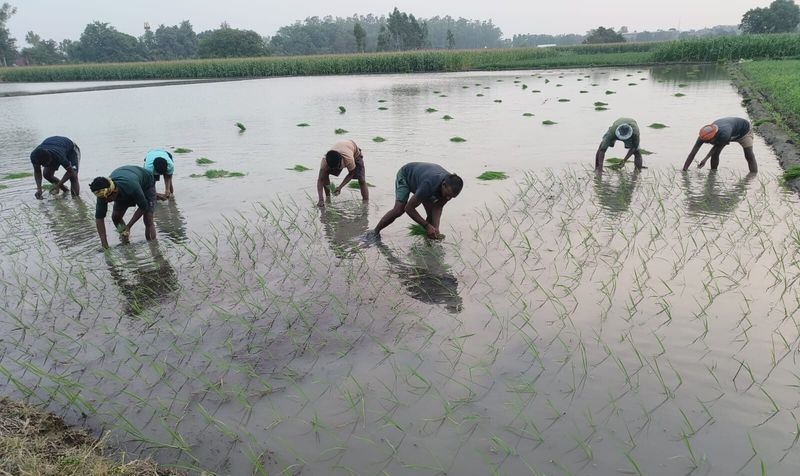
With the official commencement of paddy transplantation on June 15, agricultural activity has picked up across Haryana as farmers have started transplanting paddy saplings in their fields amid expectations of a good crop this season.
Fields lying vacant after the wheat harvest are gradually turning green, with farmers preparing to complete transplantation within the prescribed period. Nurseries of various paddy varieties have already been raised, while labourers have begun transplanting saplings in several districts.
According to the Agriculture and Farmers Welfare Department, the state has set a target of bringing around 15.60 lakh hectares under paddy cultivation this season. Karnal has been allotted the highest target of 1.85 lakh hectares, followed by Kaithal at 1.65 lakh hectares, Jind at 1.50 lakh hectares, Sirsa at 1.45 lakh hectares, Fatehabad at 1.35 lakh hectares, Kurukshetra at 1.20 lakh hectares and Hisar at 1.05 lakh hectares. Yamunanagar, Ambala and Sonepat have each been assigned a target of 90,000 hectares.
Agricultural experts estimate that nearly half of the total area will be covered under parmal varieties, which are procured by the government at the Minimum Support Price (MSP), while the remaining area is expected to be planted with basmati varieties that are purchased by private traders for domestic and export markets.
Among parmal varieties, farmers are showing preference for PR-114, PR-126 and PR-131, along with hybrid varieties such as PR-7501 and PR-2222. Demand is also strong for basmati varieties including Pusa Basmati-1509, Pusa-1121, Pusa-1718 and Pusa-1692.
Yashbir, a farmer, said he had started transplantation of PR-114 on around 10 acres and planned to cultivate Pusa-1509 basmati on another 15 acres. He said favourable weather conditions had aided the process and timely rainfall would help irrigate the fields.
Another farmer, Vikas from Indri block, said he had already transplanted basmati variety 1509 on around 10 acres and expected to complete the remaining transplantation within a week. He added that farmers were receiving regular guidance from the agriculture department and were focusing on balanced use of fertilisers and water to improve productivity and reduce cultivation costs.
Meanwhile, officials of the Agriculture and Farmers Welfare Department and scientists from various ICAR institutions are visiting villages to educate farmers on crop management, balanced fertiliser application, use of organic manures and water conservation practices.
Deputy Director Agriculture Dr Wazir Singh said field staff and technical experts had been deployed across districts to assist farmers throughout the season. He said officials, including SDOs, Block Agriculture Officers and Agriculture Development Officers, were regularly visiting villages to provide technical support.
Highlighting changing cultivation practices, Singh said farmers were increasingly adopting Direct Seeded Rice (DSR), with nearly 16,000 acres already brought under the scheme in Karnal district. He expressed confidence that transplantation would progress smoothly and make a significant contribution to Haryana’s rice production this year.