
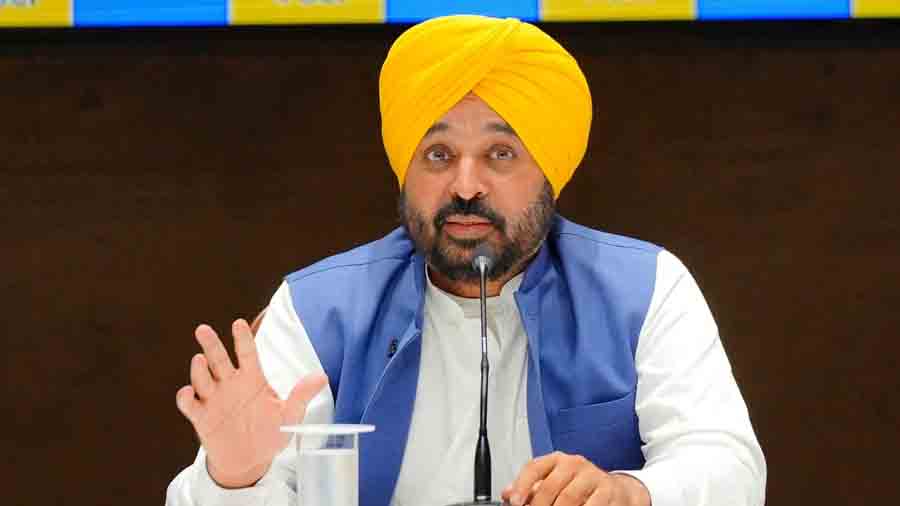
Punjab Chief Minister Bhagwant Singh Mann has strongly opposed the proposed ‘Viksit Bharat Shiksha Adhiniyam Bill, 2025’ (Higher Education Bill), warning that the legislation could make higher education more expensive, weaken opportunities for students from ordinary families and diminish the ability of states to address local educational needs. In a detailed letter to Union Education Minister Dharmendra Pradhan, CM Bhagwant Singh Mann urged the Centre to reconsider the Bill and hold wider consultations before implementing reforms that could significantly alter the higher education landscape.
Emphasising that crores of parents across the country pin their hopes and dreams on their children’s education, CM Bhagwant Singh Mann said higher education must remain a pathway of opportunity for the child of a farmer, labourer or shopkeeper, not become a burden on families. He asserted that India’s progress depends on making higher education more accessible, affordable and inclusive through greater investment in universities, infrastructure, faculty and research, rather than measures that could increase costs and centralise decision-making.
In his letter, CM Bhagwant Singh Mann stated that he is writing not merely as the Chief Minister of Punjab but as a representative of crores of parents across India whose biggest hopes are linked to the education of their children. “Every family wants its child to receive quality education, stand on his or her own feet, secure dignified employment and contribute to the progress of the nation. That is why education is not merely an administrative subject; it is a question concerning India’s bright future,” he said.
The Chief Minister said, “I initially hoped the proposed legislation would strengthen the quality, accountability and global competitiveness of higher educational institutions. However, after carefully studying the Bill, I have serious concerns that it seeks to centralise most important decisions relating to higher education, with far-reaching consequences for students, teachers, universities and state governments.”
Raising his first major concern, CM Bhagwant Singh Mann said the Bill appears to focus more on centralisation of power than on improving educational quality. “The success of an education system depends upon how effectively it understands the needs of students, teachers and local communities. In a country as vast and diverse as India, every state faces different social, economic and educational challenges,” he said.
The Chief Minister observed that it was natural to expect legislation on higher education to focus on quality, research, innovation, employability and global competitiveness. However, after studying the Bill, it appeared that its primary objective was to concentrate policy-making powers, standards, regulations, recognition mechanisms and appellate powers in the hands of the Union Government. “Education is a subject in the Concurrent List of the Constitution. Therefore, while minimum national standards may be desirable, states must retain the freedom to develop systems according to their own circumstances and needs. Unfortunately, this Bill appears to disturb that constitutional balance,” he said.
Drawing attention to the dangers of excessive centralisation, CM Bhagwant Singh Mann referred to the functioning of central institutions such as the National Testing Agency (NTA). “Recent years have raised serious questions regarding examination management, transparency and credibility. When central institutions themselves are struggling with such challenges, it is legitimate to ask whether further centralisation of higher education is really the right direction,” he said.
The Chief Minister asserted that the better path would be greater cooperation between the Centre and the states. “Successful models developed by different states should be shared across the country. Decision-making should become more participatory and collaborative. Unfortunately, this Bill appears to move in the opposite direction,” he said.
CM Bhagwant Singh Mann also expressed concern that the proposed legislation could make higher education more expensive. “While studying the Bill, an important question emerged before me. If most powers are concentrated with the Union Government, if the role of state governments continues to shrink and if central regulatory control over state universities and colleges increases, where will the financial resources required for the operation and development of these institutions come from?” he asked.
The Chief Minister pointed out that the Bill does not provide a satisfactory answer to this question. “If decision-making powers are centralised while adequate financial support is not guaranteed, universities will inevitably face pressure to raise revenues. This could lead to higher fees, greater dependence on self-financed courses and increased reliance on private investment,” he said.
The Chief Minister also raised concerns regarding the gradual privatisation of higher education. “After studying the Bill, it appears that India’s higher education system may slowly be pushed towards a model where public institutions become weaker and dependence on the private sector steadily increases,” he said.
He warned that if policy-making, regulation and control become completely centralized without clear financial responsibility, public universities could increasingly be forced to depend upon private institutions and private capital. “The direct impact of such a shift will be borne by lakhs of students whose parents continue to make tremendous sacrifices to send them to colleges and universities,” he said.
Reiterating his appeal, CM Bhagwant Singh Mann urged the Union Government to withdraw the Bill and replace it with a framework that makes education more accessible, affordable, high-quality and responsive to the needs of states. “Nations do not become great by exercising control over education. Nations become great by investing in education,” he concluded.