
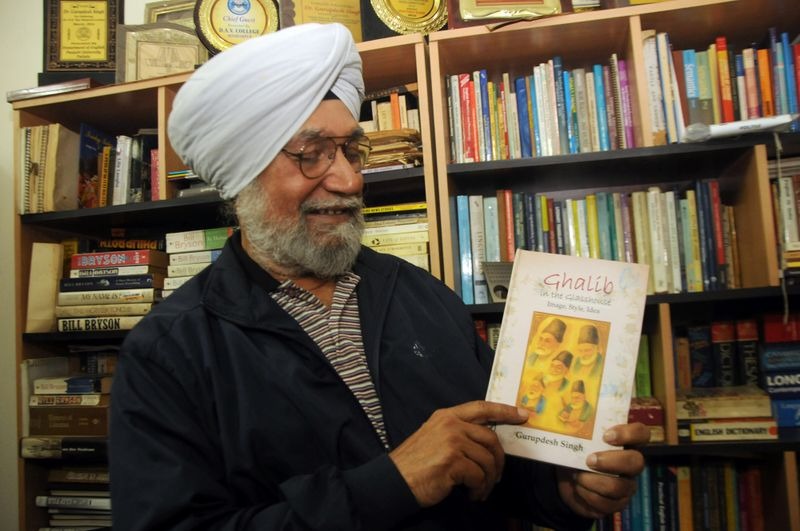
Reading Mirza Ghalib has long been considered an intense literary experience, marked by layered emotions and meanings that often leave readers searching for interpretation. His couplets, admired for their depth and complexity, continue to invite multiple readings across generations.
In an effort to simplify and re examine some of these works, author, academician and literary critic Gurupdesh Singh has released his latest book, Ghalib in the Glasshouse. The book presents an interpretation of Divan-e-Ghalib, a collection of 234 Urdu ghazals composed by the celebrated poet.
Noted scholar Anisur Rahman, author of The Essential Ghalib and a recipient of the Sahitya Akademi award, described the work as offering “an entirely different perspective on Ghalib.” Literary critic and translator Alok Bhalla, known for Partition Dialogues, said the book establishes a close link between the grandeur of Ghalib’s writing and his romantic as well as metaphysical doubts.
Calling Divan-e-Ghalib a compact reflection of the poet’s personality, Singh said it captures Ghalib’s poetic self expression, expansive worldview, personal struggles, wit and intelligence. He noted that while readers often find the ghazals engaging, they are not always certain what exactly stirs their emotions.
Singh referred to Ghalib as a “whole package,” explaining that the poet challenges and mesmerises readers while displaying an intellect that often touches the borders of mysticism. According to him, the ghazals reveal not just a romantic figure but a thinker shaped by worldly and spiritual wisdom, human courage and vulnerability, alongside mastery over composition.
Before this work, Singh had focused on interpreting the poetry of Nasir Kazmi, one of the most celebrated contemporary Urdu poets whose writings reflected the pain of Partition, displacement and longing. A former Professor of English at Guru Nanak Dev University, Singh has also worked as a linguistic scholar and translator.
Driven by his passion for poetry, Singh said Ghalib continues to gain new meanings for younger readers. He observed that the poet frequently layered his verses with metaphors, turning them into an intellectual exercise. While Ghalib has often been interpreted through his life events and letters, Singh’s study approaches the ghazals through their rhetoric, style, themes and humour.
For the research, Singh relied on the version used by Frances Pritchett, professor of Modern Indic Languages at Columbia University, which in turn draws from the 1958 edition of Divan-e-Ghalib edited by Imtiyaz Ali Arshi.