
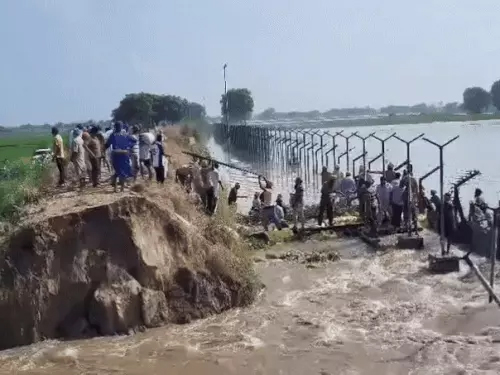
At least 23 people have lost their lives and more than 1,018 villages are reeling under floodwaters in Punjab, where devastating rains and overflowing rivers have triggered the worst flooding in decades. The state government said 16,039 people have been rescued so far, while relief material is being rushed to those still stranded.
According to official figures, eight deaths have been reported in Pathankot, seven in Hoshiarpur, three each in Rupnagar and Barnala, and two in Gurdaspur. While the Barnala victims died during heavy rains earlier this week, others were swept away as swollen Ravi, Beas and Sutlej rivers breached embankments and inundated homes.
Chief Minister Bhagwant Mann on Friday chaired a review meeting with top officials and constituted a high-powered panel to monitor relief and rescue operations, which are being conducted jointly by the Army, BSF, Air Force and NDRF. He asked Chief Secretary KAP Sinha to intensify measures, noting that an unprecedented discharge of 14.11 lakh cusecs in the Ravi had caused large-scale destruction.
Social Security Minister Baljit Kaur said her department was focusing on vulnerable groups, including the elderly, children and women, while coordinating with the Health Department to prevent outbreaks of water-borne diseases.
Floodwaters are now moving from Majha and Doaba regions to parts of Malwa. Though the Ghaggar subsided in Mohali and Patiala after touching 70,000 cusecs in the morning, rising levels in the Tangri and Markanda rivulets put Patiala district on high alert. Water also crossed 30,000 cusecs in Sardulgarh. In Gurdaspur, the Ravi is still flowing at 4.60 lakh cusecs, submerging 323 villages. In Pathankot, 81 villages remain affected, while in Amritsar water shifted from Ramdas towards Ajnala, hitting 15 villages.
Leaders from across the political spectrum, including AAP’s Raghav Chadha and Laljit Bhullar, BJP’s Sunil Jakhar, Congress leaders Charanjit Singh Channi, Partap Singh Bajwa and Raja Warring, and SAD chief Sukhbir Badal, visited flood-hit areas, urging party workers to assist in relief. Farmer unions such as BKU (Ugrahan), BKU (Ekta Dakaunda) and Kirti Kisan Union also joined rescue efforts.
Officials reported that levels in Tarn Taran, Hoshiarpur and Kapurthala have begun receding, though normalcy will take days. The Beas registered 1.80 lakh cusecs near Tanda and 2 lakh cusecs near Dhilwan.
Water levels in Pong, Ranjit Sagar and Bhakra dams have also started to ease. Controlled releases are underway, though Pong remains above the danger level at 1,391 feet, forcing authorities to discharge one lakh cusecs.
The situation has also revived the long-standing Punjab-Haryana water dispute. On August 22, Punjab wrote to Haryana and Rajasthan, offering additional water to ease flooding. Haryana, however, responded only on Friday, asking Punjab to slow down releases as its own rivers were in spate.