
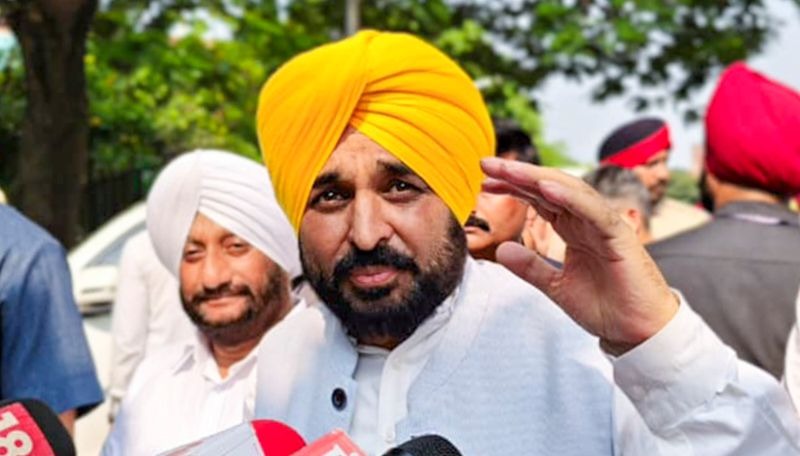
A political confrontation has erupted between Punjab and Rajasthan after the Bhagwant Mann-led AAP government asserted its right to claim royalty on river waters flowing to the neighbouring state, triggering a sharp response from the BJP-ruled Rajasthan government.
The row intensified after Mann demanded Rs 1.44 lakh crore as dues from Rajasthan, claiming the amount has been pending since 1960. He said Punjab would approach the court if needed, adding that Rajasthan could present its stand there.
Rejecting the claim, Rajasthan Water Resources Minister Suresh Singh Rawat said the basis of Punjab’s demand rested on a 1920 agreement signed during the British era, which he termed legally untenable in the present context. He maintained that such arrangements could not be enforced in today’s constitutional framework.
Punjab has, however, formally escalated the matter by writing to the Rajasthan government. The state has cited a September 4, 1920 agreement signed in Simla between the Maharaja of Bikaner, the Nawab of Bahawalpur and the then Punjab province on sharing of river waters. According to Punjab, Rajasthan continued to pay water royalty until the signing of the Indus Waters Treaty in 1960.
Officials pointed to the Sutlej Valley Project of 1920 under which the British administration imposed a water cess of Rs 6.50 per acre annually on the Bikaner state in exchange for water supplied through the Hussainiwala Headworks from 1927.
Punjab has further argued that Rajasthan is currently charging farmers around Rs 70 per acre per crop for irrigation water, generating an estimated annual revenue of Rs 65.20 crore, strengthening its claim for royalty.
The issue has also triggered political reactions within Punjab. Shiromani Akali Dal president Sukhbir Singh Badal termed Mann’s move a “knee-jerk reaction,” alleging it followed his own announcement that an SAD government would not allow even a drop of water to flow into the Rajasthan canal.
With both states firm on their positions, the dispute is expected to escalate further, with legal intervention likely if no resolution is reached through dialogue.